अर्थव्यवस्था और फिनटेक: ₹2,000 से अधिक के UPI लेनदेन पर MDR लगाने के खिलाफ याचिका पर सुप्रीम कोर्ट करेगा सुनवाई
28 Sep 2026
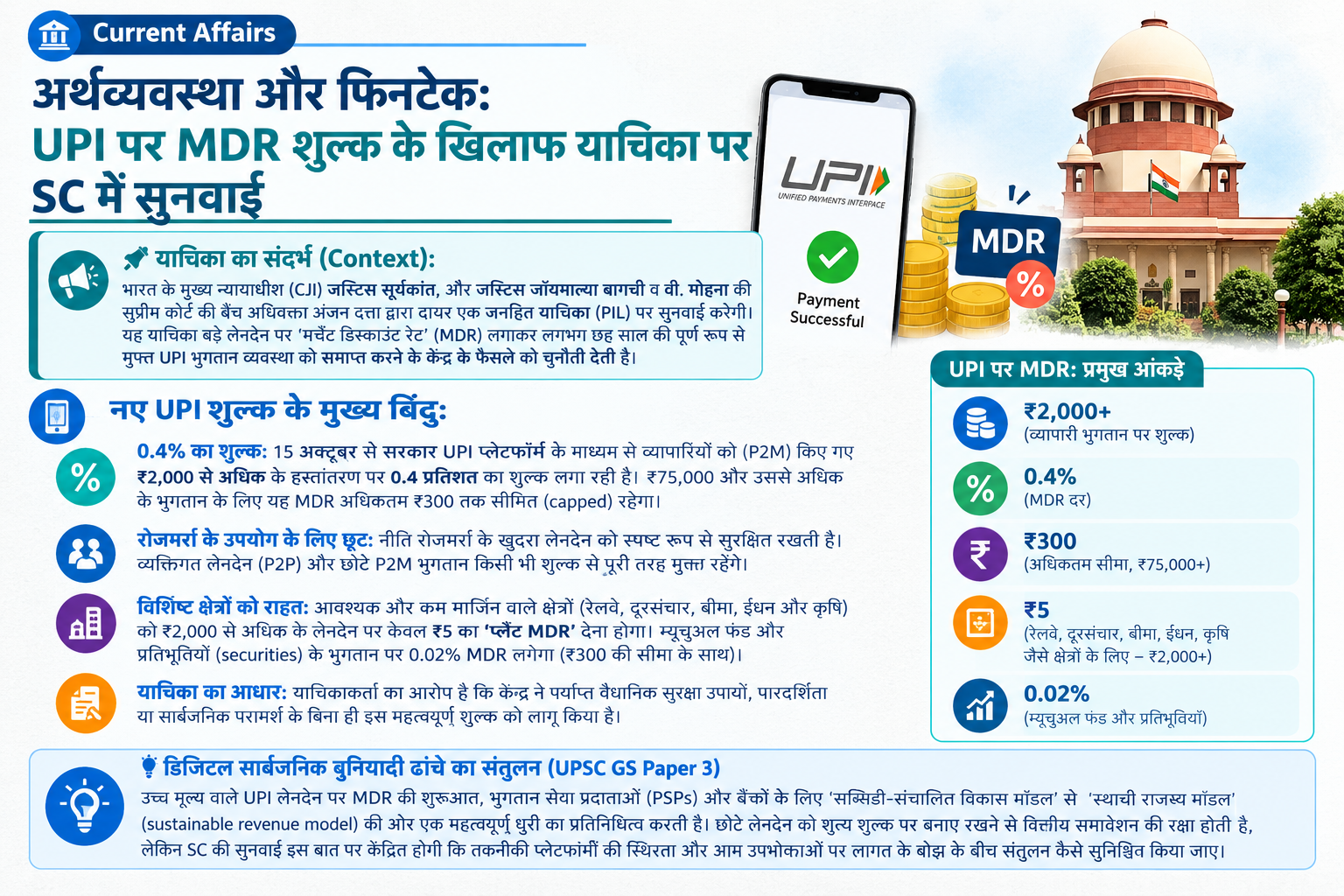
सुप्रीम कोर्ट 15 अक्टूबर से ₹2,000 से अधिक के UPI P2M लेनदेन पर 0.4% मर्चेंट डिस्काउंट रेट (MDR) लगाने के केंद्र के फैसले को चुनौती देने वाली जनहित याचिका (PIL) पर सुनवाई करेगा।
भारत के मुख्य न्यायाधीश (CJI) जस्टिस सूर्यकांत, और जस्टिस जॉयमाल्या बागची व वी. मोहना की सुप्रीम कोर्ट की बेंच अधिवक्ता अंजन दत्ता द्वारा दायर एक जनहित याचिका (PIL) पर सुनवाई करेगी। यह याचिका बड़े लेनदेन पर 'मर्चेंट डिस्काउंट रेट' (MDR) लगाकर लगभग छह साल की पूर्ण रूप से मुफ्त UPI भुगतान व्यवस्था को समाप्त करने के केंद्र के फैसले को चुनौती देती है।
- 0.4% का शुल्क: 15 अक्टूबर से सरकार UPI प्लेटफॉर्म के माध्यम से व्यापारियों को (P2M) किए गए ₹2,000 से अधिक के हस्तांतरण पर 0.4 प्रतिशत का शुल्क लगा रही है। ₹75,000 और उससे अधिक के भुगतान के लिए यह MDR अधिकतम ₹300 तक सीमित (capped) रहेगा।
- रोजमर्रा के उपयोग के लिए छूट: नीति रोजमर्रा के खुदरा लेनदेन को स्पष्ट रूप से सुरक्षित रखती है। व्यक्तिगत लेनदेन (P2P) और छोटे P2M भुगतान किसी भी शुल्क से पूरी तरह मुक्त रहेंगे।
- विशिष्ट क्षेत्रों को राहत: आवश्यक और कम मार्जिन वाले क्षेत्रों (रेलवे, दूरसंचार, बीमा, ईंधन और कृषि) को ₹2,000 से अधिक के लेनदेन पर केवल ₹5 का 'फ्लैट MDR' देना होगा। म्यूचुअल फंड और प्रतिभूतियों (securities) के भुगतान पर 0.02% MDR लगेगा (₹300 की सीमा के साथ)।
- याचिका का आधार: याचिकाकर्ता का आरोप है कि केंद्र ने पर्याप्त वैधानिक सुरक्षा उपायों, पारदर्शिता या सार्वजनिक परामर्श के बिना ही इस महत्वपूर्ण शुल्क को लागू किया है।
उच्च मूल्य वाले UPI लेनदेन पर MDR की शुरुआत, भुगतान सेवा प्रदाताओं (PSPs) और बैंकों के लिए 'सब्सिडी-संचालित विकास मॉडल' से 'स्थायी राजस्व मॉडल' (sustainable revenue model) की ओर एक महत्वपूर्ण धुरी का प्रतिनिधित्व करती है। छोटे लेनदेन को शून्य शुल्क पर बनाए रखने से वित्तीय समावेशन की रक्षा होती है, लेकिन SC की सुनवाई इस बात पर केंद्रित होगी कि तकनीकी प्लेटफार्मों की स्थिरता और आम उपभोक्ताओं पर लागत के बोझ के बीच संतुलन कैसे सुनिश्चित किया जाए।
Economy & Fintech: SC to Hear Plea Against MDR on UPI Transactions Above ₹2,000
28 Sep 2026
The Supreme Court is set to hear a PIL challenging the Centre's recent decision to impose a 0.4% Merchant Discount Rate (MDR) on specified UPI Person-to-Merchant (P2M) transactions exceeding ₹2,000, effective October 15.
A Supreme Court bench comprising Chief Justice of India Justice Surya Kant, and Justices Joymalya Bagchi and V Mohana will hear a Public Interest Litigation (PIL) filed by advocate Anjan Datta. The plea challenges the Centre’s decision to end the six-year era of fully free UPI payments by levying a Merchant Discount Rate (MDR) on large transactions.
- The 0.4% Charge: Starting October 15, the government is introducing a 0.4% fee on Person-to-Merchant (P2M) UPI transfers exceeding ₹2,000. This MDR will be capped at a maximum of ₹300 for payments of ₹75,000 and above.
- Exemptions for Everyday Use: The policy explicitly ring-fences everyday retail transactions. Person-to-Person (P2P) transfers and small P2M payments remain completely free from any charges.
- Sector-Specific Relaxations: Essential and thin-margin sectors (railways, telecom, insurance, fuel, and agriculture) will incur only a flat MDR of ₹5 per transaction above ₹2,000. Furthermore, mutual funds and securities transactions will attract a nominal 0.02% MDR (capped at ₹300).
- Grounds for the PIL: The petitioner alleges that the Centre introduced this significant levy without adequate statutory safeguards, market transparency, or sufficient public consultation.
The introduction of MDR on high-value UPI transactions represents a critical pivot from a 'subsidy-driven growth model' to a 'sustainable revenue model' for Payment Service Providers (PSPs) and banks. While maintaining zero charges on small transactions protects financial inclusion, the SC hearing will heavily debate the balance between operational sustainability for tech platforms and preventing a cost pass-through to ordinary consumers.